Open-source contributions
Our work is shared with the community via open-source software, datasets, and tools.
📦 Open-Source Packages
Publicly released tools and libraries for the research community.
CLIP-CAM is an open-source Python package for generating Grad-CAM–style visual explanations in Vision Transformer (ViT)–based CLIP models, enabling deeper insight into how specific image regions drive image–text similarity scores.
- Modular and extensible framework for visualizing cross-modal attention in CLIP, built around Grad-CAM–based heatmap generation.
- Customised for CLIP's dual-encoder architecture, revealing which image patches contribute most to a given text query.
- Lightweight API — works with standard HuggingFace and OpenAI CLIP checkpoints with minimal setup.
Tech Stack & Topics
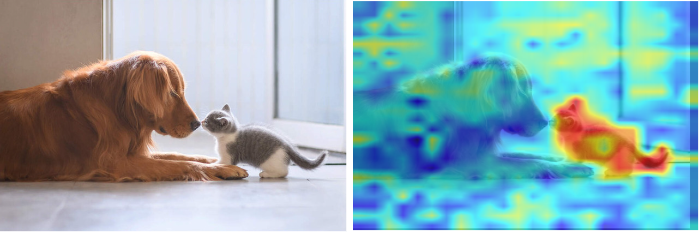
Attention heatmap over the image for a given text prompt.
🗄️ Dataset Contributions
Benchmarks and datasets released to advance research in multi-modal perception and autonomous systems.
 CVPR-W · Public
IndraEye
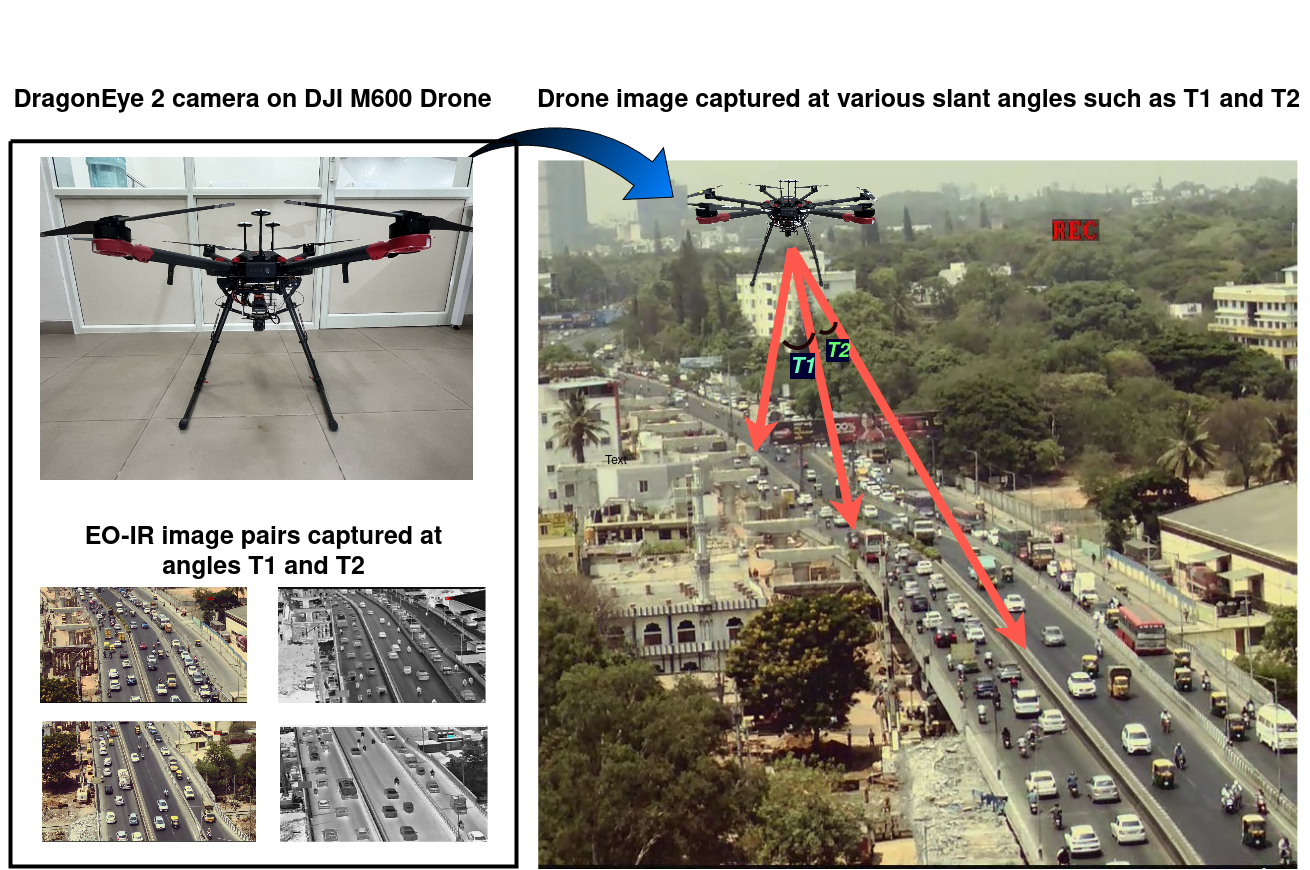
First Multi-View Drone RGB-IR Dataset from the Indian Subcontinent
The first multi-view drone-based RGB-IR dataset from the Indian subcontinent, built to support robust and accurate real-world vision systems. Captures diverse conditions spanning multiple viewpoints, altitudes, and backgrounds, with variations across times of day to evaluate robustness under changing illumination.
- Benchmarked for object detection and semantic segmentation tasks.
- Multi-altitude captures covering slant-angle, nadir, and oblique drone perspectives.
- Illumination diversity: dawn, daylight, dusk, and low-light conditions included.
 Public · Benchmark
AetherVision-Bench
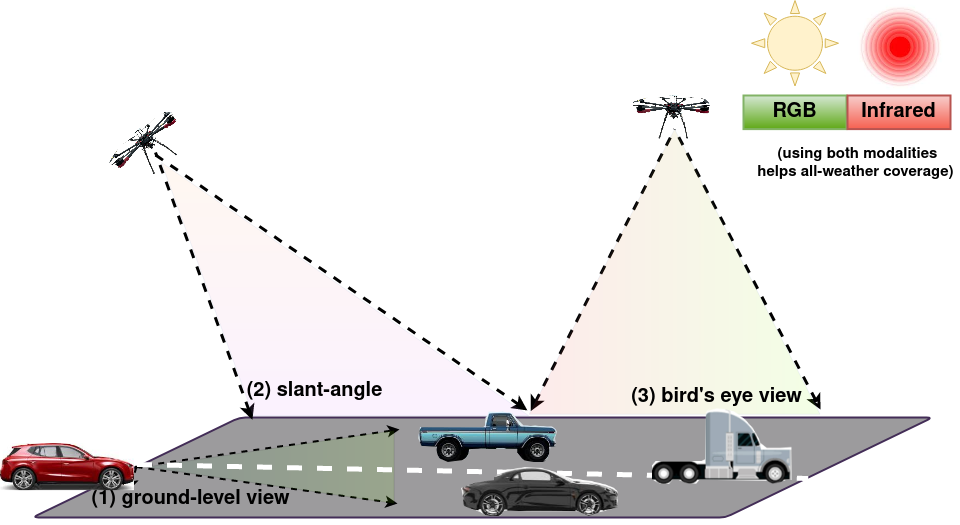
Open-Vocabulary RGB-IR Benchmark · Multi-Angle Segmentation
Large-scale benchmark consolidating 13+ datasets across RGB and infrared modalities for open-vocabulary segmentation evaluation across aerial and ground perspectives. Introduces MSRIQ, a novel metric for cross-modal segmentation uncertainty, and an object-localization track for foundation VLMs.
 IEEE OCEANS · Public
Side Scan Sonar Dataset
Diffusion-Synthesised SSS Data for Underwater Mine Detection
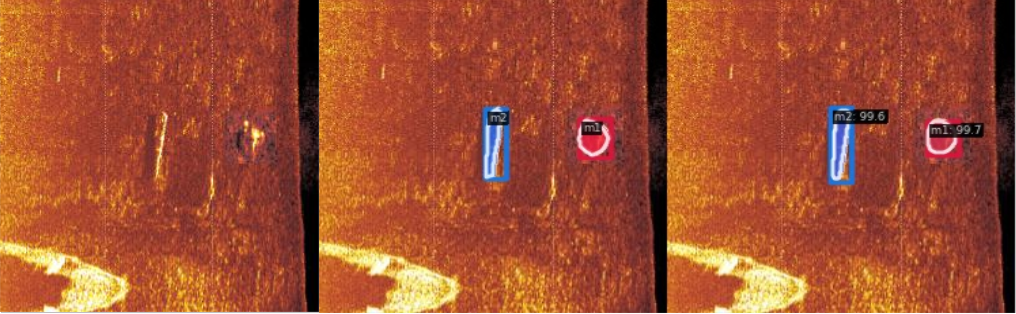
A synthetic side-scan sonar (SSS) dataset generated via diffusion-based modelling, addressing the critical scarcity of real-world SSS data that causes overfitting and poor generalisation in underwater deep learning pipelines. Enables robust training for mine-like object detection and segmentation in unseen underwater environments.
- Highlights data scarcity as a root cause of degraded generalisation, and proposes synthetic augmentation as a scalable fix.
- Demonstrates significant improvements in object detection and semantic segmentation on downstream benchmarks.
- Published at IEEE OCEANS and IEEE Geoscience & Remote Sensing Letters.
 IROS 2024 · Research
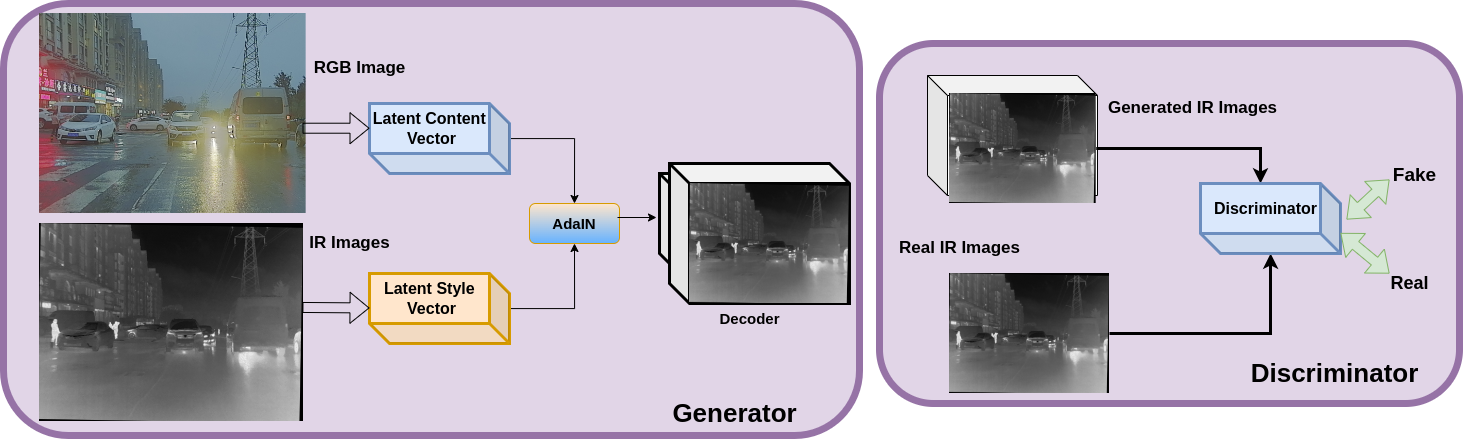
Simulated IR Dataset
SSL-RGB2IR · Self-Supervised Infrared Generation for Perception Training
Infrared imagery dataset generated via SSL-RGB2IR, a self-supervised RGB-to-IR image-to-image translation framework, supporting thermal perception and multi-modal learning for robotics in low-light environments.
- Deep learning models trained on SSL-RGB2IR–generated IR images consistently outperform models trained on other translation methods.
- Demonstrates consistent performance gains in semantic segmentation and object detection, particularly in sim-to-real transfer scenarios.
- Bridges the modality gap where paired real IR data is scarce or costly to collect.
 IndraEye